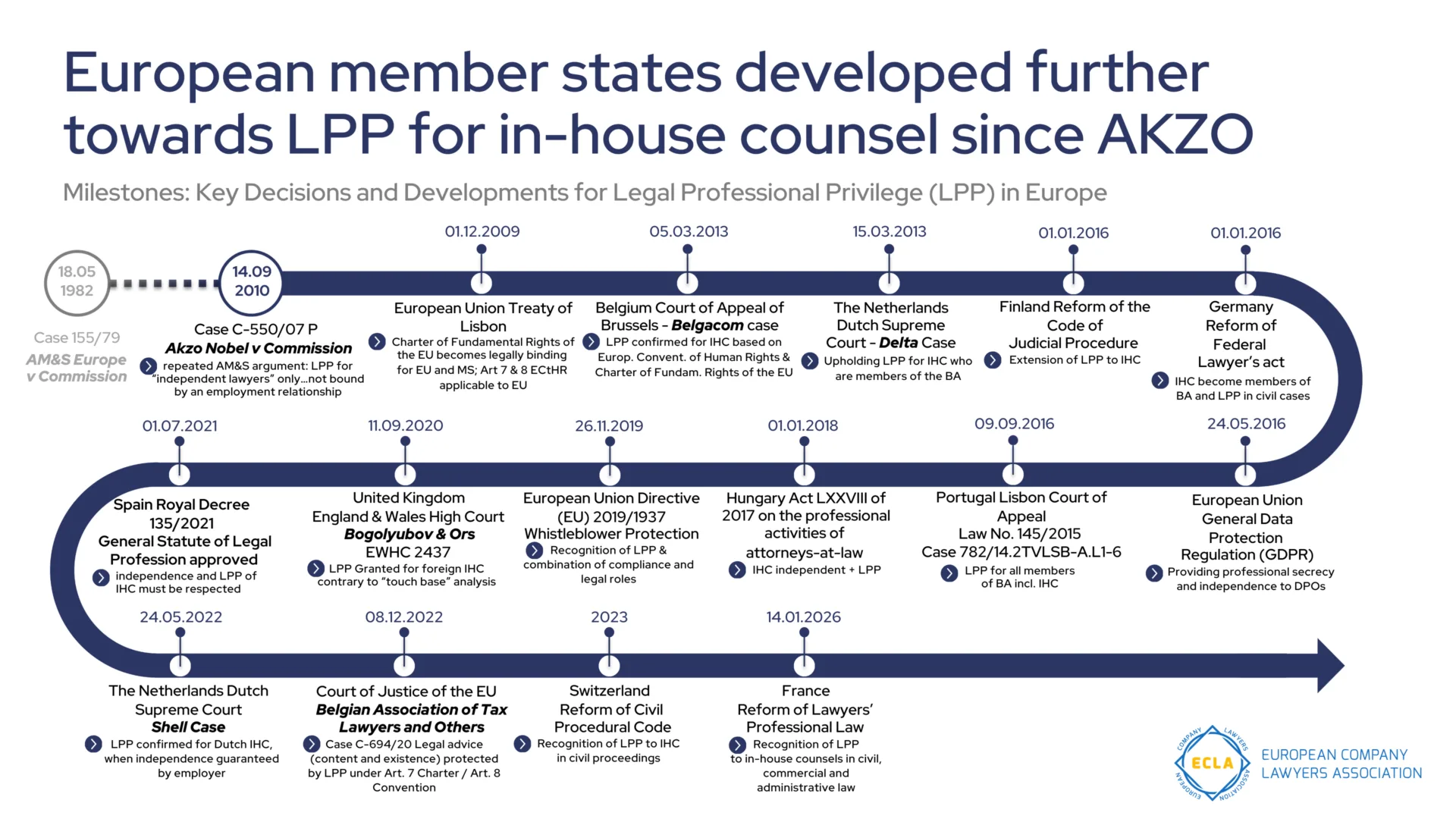

The Company Lawyer Profession
The corporate legal profession is the most dynamic path in the modern legal world. It shifts with jurisdiction, industry, risk tolerance, and scale. The company lawyer can be a glorified clerk or the architect of a multinational’s strategy. In many places it is both: compliance at 10:00, crisis management at 10:30, contracts at 11:00.
A company can survive without a legal department – it cannot scale safely without one. Businesses that are large, regulated, cross-border, or reputationally exposed need a trusted team that owns legal risk and shapes strategy. You can outsource tasks, not accountability.
The value of external counsel is easy to price: the cost and exposure of litigation, or the value of an M&A deal. The value of the in-house lawyer is harder to quantify because their metric is silence. Success is the lawsuit that was never filed, the regulatory fine that was never levied, and the front-page scandal that never went to print. External counsel do not live with the commercial trade-offs, the operational constraints, or the long-term incentives of the business. Their value is real, but it is episodic. An in-house legal function is structural.
“Corporate legal department” has become a misleadingly simple label. It can be a centralised hierarchy, a distributed network of specialists, or a lean team that directs outside counsel with ruthless selectivity. It can be a function that has automated away the drudgery that once defined it, leaving judgement as the centre of gravity. It can be the place where geopolitics, sanctions, supply chains, data regulation, and board accountability are translated into operational reality before they become headlines. In this environment, the lawyer is no longer defined by billable hours or business development – the part many went to law school to avoid. You do not need to sell – you need to solve.
Many corporate lawyers have come to the same conclusion: this is the most compelling way to practise law inside modern institutions. It produces deep industry expertise, forces proximity to decision-making, and rewards clarity over theatre. The work is less about performative brilliance and more about durable outcomes: building systems that hold when incentives diverge and pressure rises. The typical status games of the legal profession – visibility, billables, personal brand – matter less than whether the company keeps its licence to operate, treats stakeholders fairly, and earns trust in the market.
The best ship is the one that did not sink. Most successful companies are built not only on ambition and execution, but on the quiet scaffolding that prevents avoidable failure. Corporate legal teams rarely get credit for what never happened. Their work is why it didn’t.
Privilege, confidentiality, and independence
In Europe, in-house and external counsel have been separated by a core variable that encapsulates how companies document risk, seek advice, and defend themselves: the scope of legal professional privilege.
Legal professional privilege exists for a simple reason: a company cannot comply with the law without being able to ask for candid legal advice. Privilege is not a perk for lawyers. It is a governance tool that protects the integrity of legal analysis, enables remediation before harm occurs, and supports the right of defence when disputes arise.
Across Europe, that protection is fragmented. Some jurisdictions extend strong protection to in-house legal advice, others do not, and several sit in-between with confidentiality regimes that protect certain documents under strict conditions. The result is predictable: the more cross-border the business, the less predictable the protection.
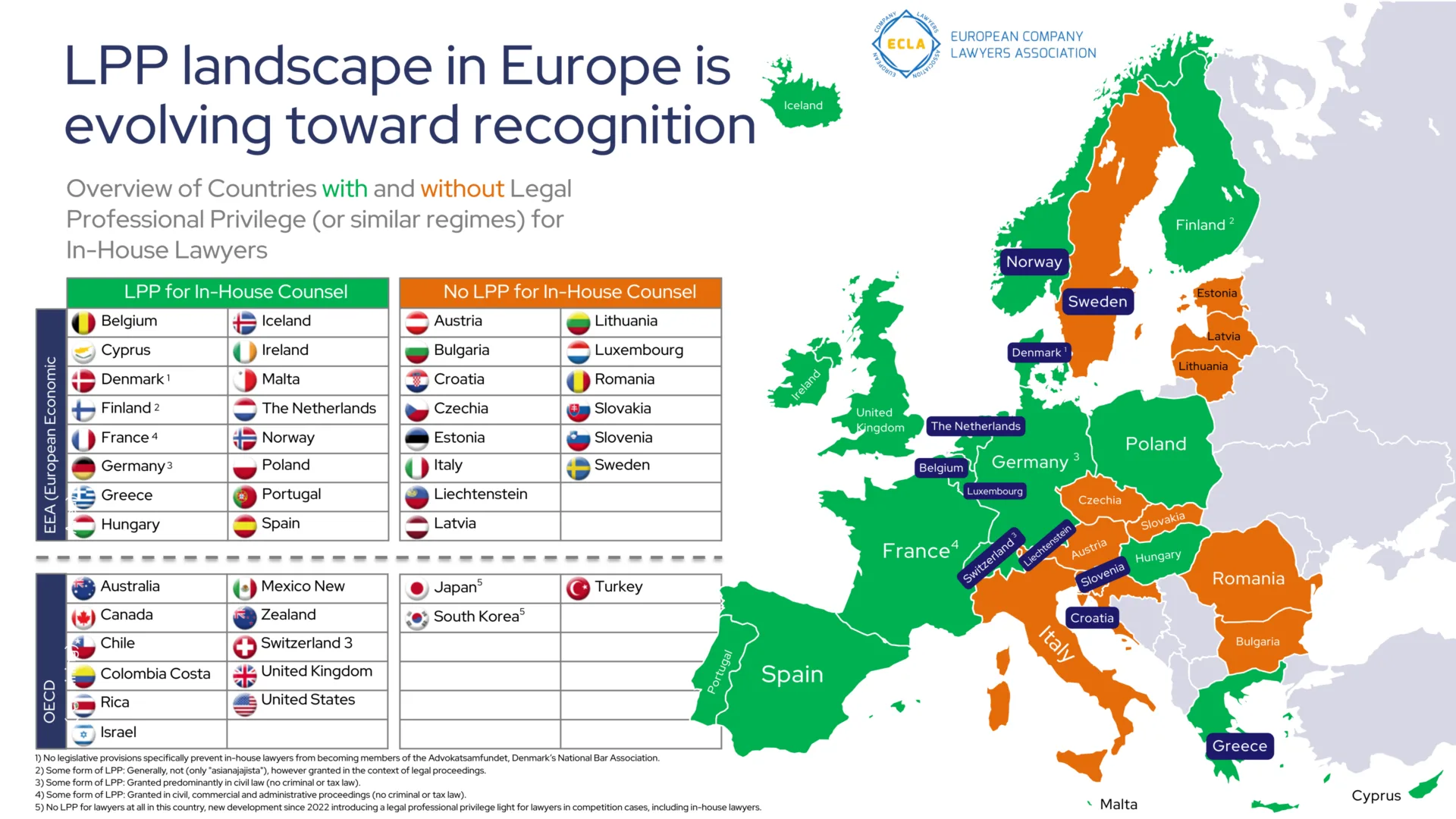
At EU level, the position in competition investigations remains anchored in the case-law that limits EU legal professional privilege to communications with independent external counsel, excluding employed in-house lawyers on the basis that an employment relationship compromises independence. The Commission’s 2025 Competition Policy Brief explicitly reaffirms that it sees no reason to depart from this settled approach.
That logic is neat in theory and increasingly strained in practice. “Independence” is treated as a status label rather than a functional reality. Large law firms are commercial organisations. They are economically dependent on clients, exposed to conflicts, and structured around incentives (origination, billing, partner politics) that can distort judgement just as surely as an employment contract can. Similarly, a smaller law firm’s clients each comprise a substantial portion of their recurring revenue. The idea that external counsel are structurally immune to pressure while in-house lawyers are structurally compromised is not a serious description of how modern legal services operate; it is a formalism.
The effects are odd. When privilege follows the letterhead rather than the legal function, it rewards cosmetic routing of advice – copying external counsel, shifting internal analysis into “shadow” formats, or avoiding documentation entirely. That does not strengthen compliance. It weakens it: fewer written risk assessments, less auditable remediation thinking, and higher organisational reliance on after-the-fact explanations.
France’s January 2026 reform shows the shape of the European compromise. Rather than recognising full privilege for in-house counsel, France moved toward a statutory confidentiality regime that attaches to defined written in-house legal consultations if strict conditions are met (qualification, training, restricted recipients, exact labelling and filing). It is deliberately narrow: it does not apply in criminal or tax proceedings, and it is carved back against EU authorities’ control powers. This is a political design choice: enable a more compliance-friendly documentation culture without conceding the full symbolism of “privilege” – and without colliding with the EU competition-law position.
The core point is not that in-house advice should be untouchable. The point is that using “employment” as a blunt proxy for (non)independence fails both governance and enforcement. Privilege should track professional duty, legal function, and safeguards against abuse – not a simplistic distinction that ignores how external counsel and in-house teams actually work.
Compromise or not, the direction is clear: the debate on legal professional privilege is active once again, and incremental progress is real. Governments have started to treat privilege not as a corporatist indulgence but as part of a jurisdiction’s competitiveness and compliance infrastructure. Legal teams tend to cluster around headquarters, and multinationals place high-value decision-making where internal legal analysis can be produced, stored, and used without becoming an evidentiary weapon by default. Where that safeguard is missing, companies adapt – by rerouting advice to external counsel, relocating sensitive functions, or documenting less. None of those outcomes is good for enforcement, investment, or governance.